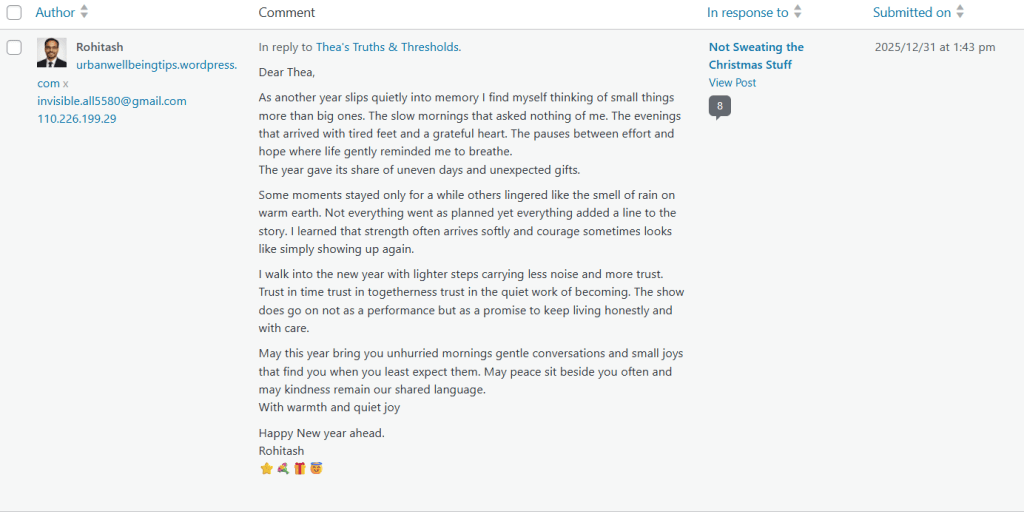
There are responses that look polished, grammatically correct, even “perfect.” They use all the right words, the right tone, the right gestures of care. But for those of us with heightened sensitivity, discernment, and well‑developed pattern recognition, something feels off. We can sense when words are empty vessels. We can tell when care is performed rather than embodied.
That was the case with an earlier encounter I had with a wellness blogger, Rohitash Yadav of Urban Wellbeing Tips, who claimed authority but failed to practice his ethical responsibility as a journalist. He didn’t fact‑check. He didn’t think through his response. He even linked to an unrelated post — all driven by ego and self‑promotion. On the surface, it looked like he respected my boundaries. In truth, it was face‑saving performance, optics for branding and monetization.
In a previous post about the boundary violation in online interaction, When Clarity Doesn’t Need Permission,I talked about protecting my authenticity and space. That earlier reflection laid the groundwork for this one.
If Rohitash were a non‑journalist, a non‑writer, an ordinary individual without any writing background, I would have let it go. I would have charged it to lack of communication skills or expertise — not everyone is trained to connect dots. That would have been not sweating the small stuff.
But because he claimed the mantle of journalist, the disconnect mattered. Journalists are expected to think, to contextualize, to honor coherence. He didn’t. He defaulted to autopilot — branding, self‑promotion, performance. And that is why discernment demanded a boundary.
I chose not to approve his latest comment — his attempt at crafting a supposed thoughtful response to my boundary assertion. Why? Because the words were hollow and insincere. Sure, they were the “correct” words to say when being called out — but they carried no soul.
He simply mirrored my boundary, even repeating the exact words I used. And when words lack authenticity, when they are uttered only as a face‑saving attempt, without any genuine apology, they do not deserve further airtime in my space — a space he had already intruded upon.
This is typical of social media culture.
Just because platforms are public, just because readers can freely comment, they forget that these platforms are still spaces owned by the account, page, or site holder.
There is an unwritten rule: respect the space.
You ask permission, and you wait for permission to be granted before leaving anything behind — even in public places. And when you call yourself a wellness expert‑journalist, you pause. You ask yourself if your comment truly adds value to the conversation, or if it is merely noise.
I would have preferred that he added something like, “I hope it’s okay that I share the link to my post, which talks about the inner child and playfulness…” or “May I invite you to my post about the inner child and playfulness…” The absence of these words revealed a lack of respect for someone else’s space.
Rohitash had every right to share and promote his posts on his own site. But to do that in another’s space is crossing a line — a boundary violation. He should have stayed in his lane instead of using someone else’s platform to promote his brand. Even more so when what he shared was unrelated to the piece he was commenting on and linking to.
It became clear to me that he wasn’t after genuine connection. He was after self-promotion and brand visibility. That is why I chose not to approve his response‑comment and blocked him from commenting altogether.
He even had the audacity to claim that his readers trust him more than they trust themselves — and he took pride in it. That statement reveals the deeper danger:
When seekers surrender their agency to external authorities, they are left vulnerable to exploitation. This is not care. This is branding. This is monetization disguised as guidance.
It is the Old Energy at work — the hierarchical structures rooted in patriarchy, where authority is externalized and individuals are taught to defer rather than to trust their own inner compass.
Systems like the Catholic Church, among others, have long propagated this model, instilling dependency on priests, doctrines, and intermediaries instead of empowering members to listen to the Wise One Within. Even the teachings of Master Jesus have been distorted. “I am the Truth, the Way, and the Life. No one comes to the Father except through me. (John 14:6)” was never meant to demand literal mediation through him. It was an invitation to awaken the Christ Within, to recognize that the path is already inside us.
This distortion — whether in religion, health and wellness blogging, healing and trauma recovery spaces, spiritual circles, or marketing in general — serves the same purpose: to keep seekers, followers, and members dependent, to keep authority external, and to keep power concentrated in the hands of those who benefit.
I ran my interpretation by a friend.* Their reaction was the familiar refrain: “You’re reading too much into it. You’re over‑analyzing.”
Many people are socialized to prioritize politeness over intuition, to smooth over discomfort rather than name it. In Filipino culture, this often takes the form of hiya (shame) and pakikisama (get along with others) — values that emphasize avoiding shame and maintaining harmony, even at the cost of clarity. These cultural shields can make discernment look like disruption, when in truth it is protection.
And because of that discernment, I chose not to approve his comment. I blocked him from further airtime. That was boundary enforcement in practice — protecting my sanctuary from intrusion disguised as care.
This is the paradox: the majority misperceive sensitivity as weakness, as “too much.” But in truth, it is strength. A shield. A compass. It is the ceremony of clarity.
To my fellow sensitive, discerning readers: you are not alone. Our gifts are not flaws. They are the very tools that protect and guide us.
In the end, this is not about confrontation. It is about curation. It is about choosing clarity over optics, presence over performance. It is about honoring the integrity of our spaces and the signals of our own bodies.
No one puts Baby in the corner. No one puts us sensitive, discerning souls in the corner.
If any part of this speaks to you, I invite you to share your reflections in the comment section below.
Peace and Blessings,
— Thea 💙
*Update – 31 December 2025
At first, I teased my friend: “Maybe you defended the wellness blogger because you share the same DNA!” Ironically, this was the same friend who once pointed out that pattern recognition is one of my strengths — a gift I hardly noticed because it felt second nature. When I finally embraced it, used it, and presented my findings, he dismissed me. But with my determination, and when he finally saw and connected the dots, he conceded.
My discernment was right all along. Sensitivity, once again, proved itself as shield and ceremony — even in the House of Optics.

Update — as of 21 January 2026
The wellness blogger, Rohitash Yadav of Urban Wellbeing Tips, referenced in my December 29, 2025 reflection, titled, When My Clarity Doesn’t Need Permission has recently revised the “About” section of his platform. Phrases previously used to project a guru‑like authority — including “Sanctuary of Peace,” “embodies wellness in every word,” and “readers trusting him more than themselves” — have been removed. The writing approach is now framed as “coming from sincerity — not performance,” cited as the reason readers resonate with his work.
Strategic Compliance
Authentic writing needs no declaration of its authenticity; words rooted in Truth stand on their own. Non‑performative communication does not require an announcement of its nature.
The Pattern
Whether this shift followed the identification of these patterns in my December 29, 2025 piece and the succeeding pieces, including this one, that documented the arc is for readers to discern. This note is shared for the record — not for the blogger, but to safeguard the credibility of this sanctuary and uphold the standards that guide it.
Integrity of the Hearth
By documenting these shifts and linking back to the original reflection, the lineage of events remains transparent. This ensures that the “Human Signature” of this space stays intact and that performative mimicry is recognized as such, especially when violations occur.





 Thea's Truths & Thresholds