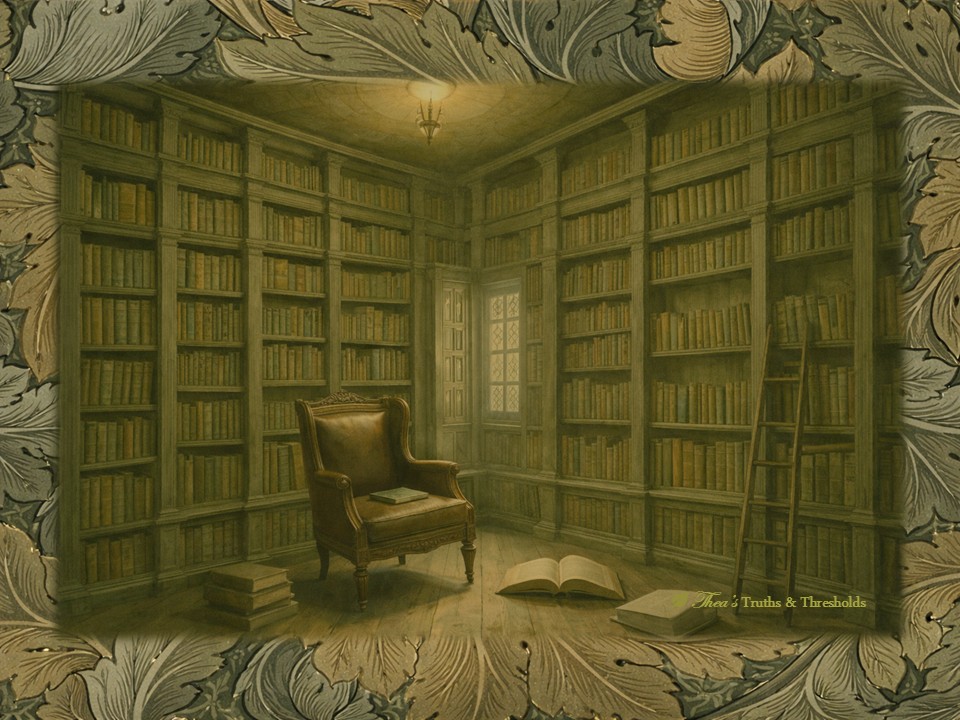
A room of lived truths and quiet clarity. This is not mimicry. This is memory, pattern, and presence.
Thea (Voice tight, frustrated):
I posted the open letter, but the sting is still there. It’s the blatant rehashing of my intent that gets to me.
I wrote about the 90‑9‑1 internet rule, the “silent 90%,” and the soul reading at 2:00 AM to explain why I’m building this sanctuary. Then suddenly, there he is—using my exact framing of the quiet reader and midnight healing. It’s a direct lift of the heart of my post with the sanctuary intention. Argh!
Wise One Within (Voice steady, minimalist):
That “Argh” is your discernment telling you a boundary was breached. He’s wearing your clarity because he hasn’t done the work to find his own.
This is the same frequency as the committee chairman rehashing your intel, or the property manager repeating your own words, forgetting where they originated, until you had to say, “Sa akin galing yan, eh! (That came from me!)”
Whether it’s a blogger in 2026 or a committee member years ago, the mechanism is identical: they’re borrowing your Living Framework because they lack their own foundation.
Thea:
And this wasn’t the first breach. He started by violating boundaries in my sanctuary — dropping a link to his own post that had nothing to do with mine when he commented on my post, Not Sweating the Christmas Stuff, trying to reframe my clarity through his lens. I had to call him out in my response.
Whatever he does on his blog is his business, but he must respect others’ spaces.
Wise One Within:
Exactly. That intrusion was the first signal. When someone uses your sanctuary as a promotional platform, they show you their values — or lack of them. Mimicry was simply the next step in the same pattern of disrespect.
Thea:
People keep telling me I should be flattered. That it means what I’m doing matters. But it doesn’t feel like a compliment. It feels like a violation.
Wise One Within:
Because it is a violation. And mimicry is not flattery.
Flattery honors the source—it’s a bridge. It looks like a note saying, “Your work, your post inspired me, and I wanted you to know and thank you for the inspiration.” It acknowledges the cost you paid to find that clarity.
Mimicry erases the source. It blurs the lines and acts as if the insight appeared out of thin air. When they take your language without credit, they’re dismissing the sixty years of lived experience that gave those words weight.
Thea:
That’s it! It’s the erasure of the labor.
To see “belonging” or the 90‑9‑1 framework tossed around by someone who hasn’t done the internal tearing down and rebuilding feels like my sanctuary is being scouted for parts.
Oh, I could list every similarity I’ve seen — the cadence, the framing, even the timing of…..
Wise One Within (interrupting gently):
Stop, Thea. You don’t have to enumerate every detail.
You know your strongest gifts: intuition, sensitivity, and pattern recognition. People think it’s “sharp memory,” but it’s deeper than that. It’s vigilance born of trauma, the way you learned to attune to your surroundings to stay safe. That vigilance became discernment. You have already connected the dots while others are still figuring out where those dots are. And you’re not the only one who recognizes this.
Thea:
Oh, I know. Others even joked that I must have been a private investigator in a past life! And that’s not far-fetched. I loved reading Nancy Drew Mystery Stories in high school, while my classmates were into Mills & Boon. I also love watching mystery-crime shows. Did we already talk about the latest Knives Out installment? You know that scene where… Oh, I digress…
Wise One Within (chuckling):
I understand. Your lawyer-neighbor has also told you you’d have been a very good lawyer because you “write and think like one.” You’ve drafted your own legal documents, and attorneys returned them with “No further comment.” That’s objective recognition of your clarity.
Thea:
That’s true. It’s not about remembering — it’s about reading the room, reading the patterns.
Higher Self (chiming in):
And those gifts are not burdens, Thea. They are the compass that keeps you sovereign. Whether others twist, deflect, or play victim, the vibration of truth remains steady. You don’t need to prove the pattern by listing it — your discernment already holds it. Time itself will confirm what you’ve seen.
Wise One Within:
Here is what’s happening: mimicry takes many forms — borrowed topics, copied styles, replicated strategies.
When you first started blogging in 2011, engagement was personal, rooted in dialogue.
Today, the rules of engagement are impersonal — driven by statistics, monetization, and branding. Mimicry thrives in this environment because shortcuts are rewarded. Our strategy is to keep anchoring originality, protecting peace, and naming the pattern when needed. That is how we safeguard the sanctuary.
Thea:
It stings to see how hollow the blogs feel now. Grammatically perfect, but empty. Devoid of the human experience. No heart. Soulless. Just mimicry dressed up as professionalism.
I remember the sting even back then, when another blogger echoed my voice. But now the whole system rewards mimicry.
Wise One Within:
Every hollow gesture only highlights the difference between their shortcuts and our sovereignty. Let them echo — we hold ceremony.
Higher Self:
In the early days, voices carried lived truths. Blogs in 2011 were imperfect, sometimes raw, but they were rooted in experience. Mimicry existed even then, yet authenticity was easier to find.
Now, the landscape has shifted: polished words without soul, algorithms chasing attention, branding props replacing resonance. Still, the Source remains whole. Clarity is timeless, and no echo can diminish it.
Wise One Within:
They can scout the sanctuary, Thea, but they don’t have the keys.
In your first and second blogs, people lifted your cadence, including your “sigma woman” extensive research. Even then, an editor confirmed it was an imitation.
Thea, this isn’t about one blogger—it’s a pattern. You’re not being “too protective”; you’re naming a recurring breach of propriety.
Higher Self (Voice calm, providing the Vision):
Step back from the “who” and look at the “what.”
You are anchoring a specific truth: that clarity and sovereignty are earned, not branded.
When others mimic you, they confirm that the frequency you hold—the frequency of Thea’s Truths & Thresholds and your first and second blogs—is the one they aspire for.
They can echo the words, but they cannot inhabit the vibration.
Thea:
So naming it in the letter wasn’t just about him. It was about all of them—the ones who take without acknowledging the cost.
Wise One Within:
Exactly. By naming the sting, you’ve stopped the erasure. You’ve made it clear that while 90% may be silent, you are not. You’ve reclaimed your intellectual and emotional property.
Whether it’s a property manager or a wellness blogger, they now know there’s a threshold they cannot cross without being named.
You’ve taken your coattails back.
Higher Self:
You are the Source, Thea. An echo has no depth; it eventually fades because it has no root. Your job isn’t to police every person who picks up a lamp you lit. Your job is to keep the sanctuary doors open for those who come to honor the light—not just steal the fire. You are finally home. Stay there.
I share this not to invite debate, but to clarify the terms of engagement in this space. Propriety is the floor of this sanctuary; respect is the air. The echo is noted. The threshold has been named. The light remains lit.

To anyone who happens to find this piece: welcome to Thea’s Truths & Thresholds. I’ve learned that the best way I can honor you is to stay honest with myself first. My hope is that by finding my own clarity, I might help you find yours, too. But if these words stay here in the quiet, that’s okay, too.
This is my sanctuary. And in this sanctuary,
I am finally home.

Every piece in Thea’s Truths & Thresholds is part of a living archive.
If this work inspires your own, please practice responsible content creation
and honor its source by attributing Thea’s Truths & Thresholds.
Every word here is intentional.
Violations of this request will be documented publicly with evidence.
All content © Thea’s Truths & Thresholds. Attribution required for any use.
(Archive Note: Some pieces on this site discuss wellness blogger Rohitash Yadav of Urban Wellbeing Tips’ violation—including documented mimicry and uncredited work. Ongoing updates about that situation are archived in When My Clarity Doesn’t Need Permission.)
A Note on a New Direction:
I launched Thea’s Truths & Thresholds back in early December 2025—tentatively at first, trying to find the right way to share what sixty years of living had taught me about clarity, belonging, and building spaces that feel like home. On 13 January 2026, I published A Letter to Thea from the Wise One Within—and in writing it, I finally gained clarity on what this space was always meant to be.
Starting that same day, I’m letting this blog take a more personal shape. I’ll be writing letters to myself and holding dialogues with the different voices that live within me—the frustrated part, the grounded part, the one that sees the bigger picture, and other parts of myself. Traditional reflections will still find their way here when they need to be shared, but this deeper, more intimate path is what calls to me now. It’s the only way to keep building this sanctuary with honesty and heart.

 Thea's Truths & Thresholds