
This is the second reflection in a series on the practice of discernment and the reclamation of self-trust.
- Part 1: Discernment, Again – The orientation: Learning to stand with the triggered self and refusing the spiritual bypass of “just letting go.”
- Part 2: Beyond False Humility: Naming the Pattern is Not Shaming – The identity: Moving from a Victim Identity to a Healing Identity by naming the patterns that violate the Sacred Hearth.
- Part 3: The Thin Slice: How Discernment Becomes Reflex – The mechanics: How self-loyalty becomes an automatic orientation through the Core Value Bank.
I’ve been sitting with what happened after I named Rohitash Yadav of Urban Wellbeing Tips—the wellness blogger-journalist.
That old jitter’s been creeping in again—the one that whispers, Are you being too loud? Too harsh? Failing at some “holiness” you left behind decades ago? In the Philippines, where we’re steeped in this specific brand of Catholic humility, we’re taught that “good” means staying quiet. That naming harm makes you the one causing disharmony.
But this “false humility”? It’s just another way to betray myself. To abandon who I’ve become just to please the ghost of who I was told to be.
What’s hit me hardest in all this—in a good way—is that I found my clarity before I had a guide for it. I’d already felt the misalignment, already walked away from him without waiting for anyone’s okay—then I came across Dr. Steven Stosny’s Living & Loving After Betrayal.
Reading his book was like looking at a photo of a place I’d already been. He talks about the “Adult Brain,” moving from “Core Hurt” to “Core Value,” that “Thin Slice” of choice between trigger and reaction. I knew those places because I’d just found my way through them. I didn’t read it to learn how to heal—I read it and saw my own healing staring back at me.
There’s such quiet power in that—knowing my growth didn’t come from following a rulebook—it came from finally listening to myself. From trusting what I knew deep down.
Now, if I were to keep that growth to myself, if I were to pretend I’m still just “struggling” when I’m actually succeeding—that would be self-silencing. It would twist kababaang-loob (true humility) into something it’s not—shrinking myself so I don’t rattle people who mix up “authority” with “integrity.”
Real kababaang-loob is inner strength. It doesn’t need to shout—but it also doesn’t need to lie about how tall it stands.
*****
Naming Rohitash wasn’t about shaming him. It was public discernment. It was me saying: Oh, I see the pattern here.
The line wasn’t just crossed when he misinterpreted my words—it was the entitlement behind it all. He walked into my private space uninvited, rearranged the metaphorical furniture, then left a piece of his own work I never asked for. No courtesy, no permission—he just acted like he’d earned the right to be there.
When I called it out, his response was like a masterclass in performative compliance—or spiritual narcissism, take your pick.
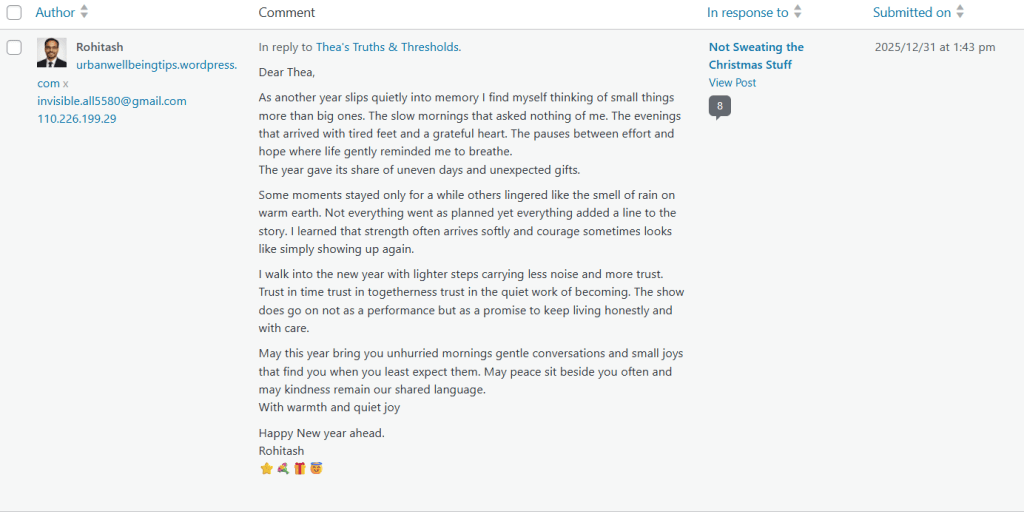
He parroted my own words back to me—trying to make me feel “seen” so I’d lower my guard. He complimented my “calm presence” and “thoughtful naming”—like patting a lion on the head while it’s trying to protect its den. Then he signed off with “With Respectful Heart”—the ultimate palusot (excuse), wrapping entitlement in sacred-sounding language to cover up the fact he’d already squatted in my space with a self-promotional link.
He knew he’d been caught. He just refused to humble himself enough to admit it or say sorry. He offered the “respectful heart” of a brand—not the honest kababaang-loob of a real person.
*****
I saw it clearly: this wasn’t a one-time mistake. It was a habit—a strategy to turn every interaction into a door for his own gain.
*****
Let me be straight: what he does on his own site is his business. What he does on mine is a violation of my “Sacred Hearth.” My space isn’t a marketplace, and I’m not a “milking cow” for someone else’s ego-driven lead generation.
On the surface, it looked like he was acknowledging my boundary—maybe even apologizing without saying the words. But in my body? I felt the friction. It was a palusot through and through. An attempt to keep his “Sanctuary of Peace” image shiny while ignoring he’d already digital-squatted in my home. I didn’t approve his last comment—I don’t owe anyone a platform for their “polite” entitlement. My sacred space isn’t a funnel for a Marketing Bot, no matter how many flower emojis they use.
By refusing to approve his ‘polite’ comment, I wasn’t being harsh; I was just being a faithful steward of my own house.
*****
In an earlier post, No One Puts Baby in the Corner: Discernment & Boundaries in Blogging Spaces, I spoke about the logistics: the link, the lack of permission, the blocked access. But here? I want to talk about how hollow words feel in your bones.
Even as he echoed my language about “adult discernment” in that unapproved reply, my body knew something was off. It was the same empty frequency I felt from people like Neale Donald Walsch or Carolyn Myss decades ago. The sound of an ego trying to “nice” its way back into a room it was told to leave.
By recognizing that “messenger who is not the message”—the same pattern I saw in those bigger names—I could shift from “personal hurt” to “conduct analysis.” If I can name the shadows in international figures, I can name the one in my own backyard, too.
*****
This is exactly what Dr. Steven Stosny means by moving from a Victim Identity to a Healing Identity.
A Victim Identity focuses on the offender. It waits for them to change, to apologize, to “get it” before it can find peace. If I’d kept his behavior secret, or tried to “manage” it quietly behind the scenes with false humility—I’d still be tied to him. Still a victim of his uninvited “furniture rearranging,” waiting for him to realize and acknowledge he was wrong.
A Healing Identity takes power back by focusing on one’s environment. It doesn’t ask the offender for permission to feel steady—it just changes the space one is in.
Naming the behavior—and yes, the person—was how I cleaned out my house.
By saying his name and calling out the “Marketing Bot” pattern, I wasn’t just “managing” the discomfort of an uninvited guest. I was putting a lock on the door.
Naming is what healers do when they say: This goes against my values. And because I see it clearly, I don’t have to engage with it anymore. I’m not waiting for people like Rohitash to live the peace they preach. I’m just living my own truth, in my own rhythm.
The work isn’t about him changing—it’s about me no longer making space for manipulation.

That unapproved performative comment was the final palusot. A man whose “About” page says he “embodies wellness in every word”—yet acts like a digital squatter, riding on my authenticity to plant his own flag.
When someone claims to be a “Sanctuary of Peace” but behaves like a Marketing Bot—the gap creates what I call “somatic dissonance” for anyone who’s paying attention.
My body felt that friction long before my mind could name the manipulation. My body knew the truth before my brain could look up a chapter and verse. It was that familiar hollow spot where integrity should have been.
And that is the biggest growth of all: I don’t need to justify walking away. I don’t need to soften what I see clearly. I don’t need a book to tell me that my “resounding No” is the holiest thing I’ve ever said.

This is what true integrity looks like: the strength to see clearly, name honestly, and walk away without apology or false humility.
In the next reflection, I’ll dive deeper into Dr. Stosny’s ideas—how discernment is intuitive more than intentional, what that “thin slice” between trigger and response really looks like, and how to tell the difference between boundaries you can bend and those you never should.
Peace and Blessings,
— Thea 💙

Update — as of 21 January 2026
Rohitash Yadav of Urban Wellbeing Tips, the wellness blogger referenced in my December 29, 2025 reflection, titled, When My Clarity Doesn’t Need Permission has recently revised the “About” section of his platform. Phrases previously used to project a guru‑like authority — including “Sanctuary of Peace,” “embodies wellness in every word,” and “readers trusting him more than themselves” — have been removed. The writing approach is now framed as “coming from sincerity — not performance,” cited as the reason readers resonate with his work.
Strategic Compliance
Authentic writing needs no declaration of its authenticity; words rooted in Truth stand on their own. Non‑performative communication does not require an announcement of its nature.
The Pattern
Whether this shift followed the identification of these patterns in my December 29, 2025 piece and the succeeding pieces, including this one, that documented the arc is for readers to discern. This note is shared for the record — not for the blogger, but to safeguard the credibility of this sanctuary and uphold the standards that guide it.
Integrity of the Hearth
By documenting these shifts and linking back to the original reflection, the lineage of events remains transparent. This ensures that the “Human Signature” of this space stays intact and that performative mimicry is recognized as such, especially when violations occur.






 Thea's Truths & Thresholds