There’s a common expectation to start the year with optimism. For me, though, a fresh start doesn’t require pretending everything is okay. I value honesty over toxic positivity, which means acknowledging what still needs my attention. I’m starting this year with compassion for the parts of me that carry past scars.
Recently, a wellness blogger-expert’s content brought up old pain. It wasn’t just his dramatic delivery; it reminded me of a version of myself that was once deceived and betrayed. Love bombed. Recognizing this isn’t “sweating the small stuff.” It is acknowledging what was real.
My trauma being triggered doesn’t excuse his behavior. A boundary violation is still a violation, and deception is still deception. The difference now is that I spot these patterns quickly. I canceled my subscription as soon as I noticed the warning signs.
Others might view this as an overreaction. As part of my healing and self-inquiry process, I tuned inward and asked myself that. This isn’t an overreaction. For those of us with a history of betrayal, a breach of space isn’t a small thing—it’s a signal. Given how misunderstood trauma is, given how uninformed society is about trauma, our protective instincts are often dismissed.
I am not overreacting; I am responding to a pattern I’ve seen before. Validating my own response is how I refuse to gaslight myself — and prevent falling into the trap of spiritual and human bypassing.
I’ve become highly aware of performative patterns: the use of sophisticated language to mask a lack of substance, inconsistent professional claims, and a focus on high-end branding over genuine transparency. These are tactics that exploit a person’s desire for meaning and connection. I don’t judge those who follow him because I was once that vulnerable. That memory helps me stay understanding and compassionate while I focus on my own path.
*****
This situation also clarified memories of my deceased, manipulative, narcissistic mother. Decades of betrayal before I cut contact made me alert to signs of manipulation and deception. While the patterns are similar, I am grateful I can now tell the difference between then and now. I am giving myself the time and space to think clearly and process the hurt without judgment — for myself and others.
And that is how I’m starting the year: integrating my experiences rather than pushing them away — welcoming and honoring whatever is coming up for healing, release, and integration. I am prioritizing my autonomy over putting on a show. I am moving forward feeling lighter, with less distraction and more trust in myself and the Divine Intelligence.
If this resonates, how do you honor yourself when old patterns resurface? If any part of this speaks to you, I invite you to share your reflections in the comment section below.
There are responses that look polished, grammatically correct, even “perfect.” They use all the right words, the right tone, the right gestures of care. But for those of us with heightened sensitivity, discernment, and well‑developed pattern recognition, something feels off. We can sense when words are empty vessels. We can tell when care is performed rather than embodied.
That was the case with an earlier encounter I had with a wellness blogger who claimed authority but failed to practice his ethical responsibility as a journalist. He didn’t fact‑check. He didn’t think through his response. He even linked to an unrelated post — all driven by ego and self‑promotion. On the surface, it looked like he respected my boundaries. In truth, it was face‑saving performance, optics for branding and monetization.
In a previous post about the boundary violation in online interaction, When Clarity Doesn’t Need Permission,I talked about protecting my authenticity and space. That earlier reflection laid the groundwork for this one.
If he were a non‑journalist, a non‑writer, an ordinary individual without any writing background, I would have let it go. I would have charged it to lack of communication skills or expertise — not everyone is trained to connect dots. That would have been not sweating the small stuff.
But because he claimed the mantle of journalist, the disconnect mattered. Journalists are expected to think, to contextualize, to honor coherence. He didn’t. He defaulted to autopilot — branding, self‑promotion, performance. And that is why discernment demanded a boundary.
I chose not to approve his latest comment — his attempt at crafting a supposed thoughtful response to my boundary assertion. Why? Because the words were hollow and insincere. Sure, they were the “correct” words to say when being called out — but they carried no soul.
He simply mirrored my boundary, even repeating the exact words I used. And when words lack authenticity, when they are uttered only as a face‑saving attempt, without any genuine apology, they do not deserve further airtime in my space — a space he had already intruded upon.
This is typical of social media culture.
Just because platforms are public, just because readers can freely comment, they forget that these platforms are still spaces owned by the account, page, or site holder.
There is an unwritten rule: respect the space.
You ask permission, and you wait for permission to be granted before leaving anything behind — even in public places. And when you call yourself a wellness expert‑journalist, you pause. You ask yourself if your comment truly adds value to the conversation, or if it is merely noise.
I would have preferred that he added something like, “I hope it’s okay that I share the link to my post, which talks about the inner child and playfulness…” or “May I invite you to my post about the inner child and playfulness…” The absence of these words revealed a lack of respect for someone else’s space.
This wellness blogger had every right to share and promote his posts on his own site. But to do that in another’s space is crossing a line — a boundary violation. He should have stayed in his lane instead of using someone else’s platform to promote his brand. Even more so when what he shared was unrelated to the piece he was commenting on and linking to.
It became clear to me that he wasn’t after genuine connection. He was after self-promotion and brand visibility. That is why I chose not to approve his response‑comment and blocked him from commenting altogether.
He even had the audacity to claim that his readers trust him more than they trust themselves — and he took pride in it. That statement reveals the deeper danger:
When seekers surrender their agency to external authorities, they are left vulnerable to exploitation. This is not care. This is branding. This is monetization disguised as guidance.
It is the Old Energy at work — the hierarchical structures rooted in patriarchy, where authority is externalized and individuals are taught to defer rather than to trust their own inner compass.
Systems like the Catholic Church, among others, have long propagated this model, instilling dependency on priests, doctrines, and intermediaries instead of empowering members to listen to the Wise One Within. Even the teachings of Master Jesus have been distorted. “I am the Truth, the Way, and the Life. No one comes to the Father except through me. (John 14:6)” was never meant to demand literal mediation through him. It was an invitation to awaken the Christ Within, to recognize that the path is already inside us.
This distortion — whether in religion, health and wellness blogging, healing and trauma recovery spaces, spiritual circles, or marketing in general — serves the same purpose: to keep seekers, followers, and members dependent, to keep authority external, and to keep power concentrated in the hands of those who benefit.
I ran my interpretation by a friend.* Their reaction was the familiar refrain: “You’re reading too much into it. You’re over‑analyzing.”
Many people are socialized to prioritize politeness over intuition, to smooth over discomfort rather than name it. In Filipino culture, this often takes the form of hiya (shame) and pakikisama (get along with others) — values that emphasize avoiding shame and maintaining harmony, even at the cost of clarity. These cultural shields can make discernment look like disruption, when in truth it is protection.
And because of that discernment, I chose not to approve his comment. I blocked him from further airtime. That was boundary enforcement in practice — protecting my sanctuary from intrusion disguised as care.
This is the paradox: the majority misperceive sensitivity as weakness, as “too much.” But in truth, it is strength. A shield. A compass. It is the ceremony of clarity.
To my fellow sensitive, discerning readers: you are not alone. Our gifts are not flaws. They are the very tools that protect and guide us.
In the end, this is not about confrontation. It is about curation. It is about choosing clarity over optics, presence over performance. It is about honoring the integrity of our spaces and the signals of our own bodies.
No one puts Baby in the corner. No one puts us sensitive, discerning souls in the corner.
If any part of this speaks to you, I invite you to share your reflections in the comment section below.
Peace and Blessings, — Thea 💙
31 December 2025
*Update:
At first, I teased my friend: “Maybe you defended the wellness blogger because you share the same DNA!” Ironically, this was the same friend who once pointed out that pattern recognition is one of my strengths — a gift I hardly noticed because it felt second nature. When I finally embraced it, used it, and presented my findings, he dismissed me. But with my determination, and when he finally saw and connected the dots, he conceded. My discernment was right all along. Sensitivity, once again, proved itself as shield and ceremony — even in the House of Optics.
Something triggered me recently. It may appear trivial. It isn’t. Because more than the event itself, what matters just as much is how I responded to it — and the fact that the event itself was a boundary violation I refuse to minimize.
In the past, when something felt off in an interaction, my instinct was to look inward first: Did I do something wrong? Did I miscommunicate? Should I let this go to keep the peace? That reflex didn’t come from humility. It came from a long history of being silenced — of learning that clarity needed to be softened, deferred, or swallowed to maintain harmony.
This time was different.
I noticed a disconnect between what I had written and how it was being framed in my own space. Nothing overt. Nothing dramatic. Just a subtle shift — an apparent re‑interpretation that didn’t belong to me or to the intention of the piece. A line had been crossed, and I noticed it.
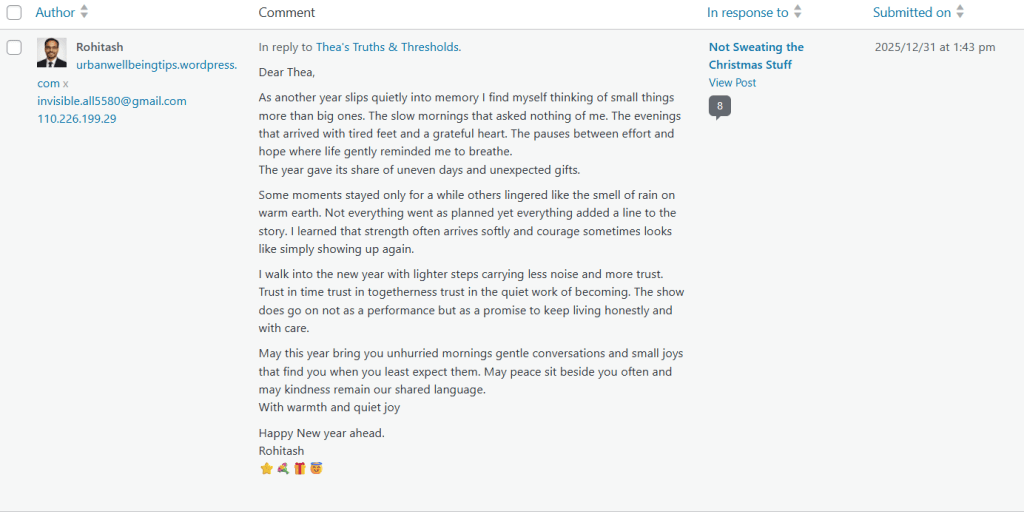
And I also found myself asking: was Rohitash deliberately misinterpreting or overriding the message of my entry? Around the same time he left his response to my comment, I read the exact same message in his other response to one of his subscribers. Was he simply operating from a default programming of promoting himself and his writing? Seeing it through this lens makes it less personal for me — but it doesn’t make what he did less wrong, more tolerable, or more acceptable.
In the past, I might have chosen silence — not because I agreed, but because silence felt safer. Silence was how peace was preserved. Silence was how discomfort was managed, especially other people’s.
Now, I’m no longer interested in that kind of peace.
What I chose instead was clarity. Calm. Direct. Proportionate. Not to correct someone, but to anchor my work where it belongs — in its own frame, on its own terms. It was about not disappearing in my own house — especially when an uninvited guest rearranged the furniture without asking permission.
This wasn’t about being right. It wasn’t about asserting authority over anyone else. It was about protecting the integrity of my own space.
Clarity isn’t about claiming authority over anyone else’s journey. It’s about claiming authority over my own.
That distinction matters, especially in a world still dismantling old hierarchies of external authority — thanks, but no thanks to patriarchy.
I’m aware that there can be many benign explanations for how people engage online — differences in habits, attention, commitment, or intention. I noticed that awareness arise, and I let it pass. Regardless of intention, though, what mattered to me was simpler: something in my space felt misframed, and I chose to address that directly.
The old fear surfaced briefly — What if this costs me approval, engagement, or connection? And just as quickly, it passed. So what? So be it.
Alignment has become my organizing principle. When something aligns, it stays. When it doesn’t, it falls away — sometimes quietly, sometimes through my intervention. Either way, I no longer manage that process by shrinking myself.
If clarity makes someone uncomfortable, that isn’t a failure of compassion. It’s simply the natural consequence of naming things honestly, without cushioning or apology.
I’m not here to teach. I’m not here to convince. I’m here to live and write from my own center and truth — and to protect the integrity of that space when needed — or invaded and intruded.
That, too, is part of not sweating the small stuff, which I have been looking much more deeply into and writing about: knowing which moments are trivial, and which ones matter enough to speak.
This interaction triggered me deeply because it echoed an earlier experience in the blogging world.
Several years ago, when I was maintaining my first blog, I contributed to a circle of writers on the theme of compassion. The blogger who invited us as guest bloggers and compiled our contributions into an e‑book had already published her piece at the start of the series.
Yet, right before mine was scheduled to appear — right before — she re‑published hers again — as a way of an intro, framed as claiming similar views. Even if that were so, it felt like she was riding on my coattails. Surely, she could have simply mentioned her piece in passing in the intro. But to republish it? Right before my piece? Others I trusted validated that interpretation. That moment led me to withdraw from the circle.
Later, during the pandemic, I dug deeply into my misaligned New Age beliefs and realized that the circle itself was steeped in what I no longer resonated with, and I eventually closed that first blog.
So when Rohitash’s recent comment appeared — mirroring itself in another response to another reader, and then inserting a self‑promotional link unrelated to my piece — it hit the same nerve. It wasn’t just about one man’s ego. It was about a recurring pattern: others riding on my authenticity, unable to accept the mirror I hold, and scrambling to reassert authority.
These moments remind me that I often find myself in this role: a mirror holder.
My authenticity and honesty reflect back what others cannot yet accept in themselves. Very few welcome that reflection. More often, it triggers insecurities, even envy, and instead of doing the shadow work, people default to projecting or posturing.
This isn’t just about one comment or one blogger. In the world of social media, authenticity and honesty are rare and refreshing — and, naturally, they are triggering to those with inflated egos who have not done their inner and shadow work but proudly claim and promote themselves as having done so.
Even in the blogging world, writers who share raw emotions and deeper truths belong to the minority. Their words often stir discomfort, defensiveness, or projection in others. That rarity is both a strength and a challenge: it makes authentic voices stand out, but it also makes them more likely to face resistance.
I have also experienced firsthand the mismatch between how famous international authors claim themselves to be authority figures while not doing the inner work themselves.
During the earlier phases of my journey, I attended seminars and workshops by names like Neale Donald Walsch and Carolyn Myss, only to be disillusioned when I saw how far the message was detached from the messenger.
Neale himself once said, “I am only the messenger, not the message.” That line stayed with me, and all this time it never felt right. To me, it sounded like an excuse to justify misbehaviors rather than an honest acknowledgment of being a work‑in‑progress. In Filipino, “palusot.”
We all are works‑in‑progress. And when someone promotes themselves as an expert or authority, we cannot be faulted for having high expectations. When they fall short, we are then asked to extend compassion because they are “only human”? No. A resounding No!
That mismatch — between message and messenger, between claim and conduct — is exactly why Rohitash’s misaligned writing and behaviors triggered me so deeply. It echoed the same pattern of self-proclaimed authority without the integrity to back it up.
I know this pattern well. My writing often mirrors back what others would rather not face. And while some celebrate that reflection, many resist it. As a highly sensitive empath, I cannot simply brush aside those mismatched energies — they land in me, they demand processing. And naming them is how I honor both my truth and my sensitivity — and what helps usher in healing and integration eventually.
Intellectually, I know what steps to take. But as with any healing and integration, it takes the body some time to catch up with what the intellect knows.
And I am acknowledging that, holding myself with compassion, and not berating myself or making myself wrong for not being able to get over it yet. Otherwise, I am the one who is re-wounding my wounded inner child rather than soothing her and making her feel heard, validated, seen, honored, and respected.
Yet while still midway in my process, when I saw the boundary violation, I unsubscribed immediately. Clarity doesn’t wait for permission — it acts. Later, when I read the About section, it validated my instinctual pull to withdraw. The words there explained the misalignment with precision, confirming what my body already knew.
Curiosity had opened the door, but discernment closed it just as quickly. That is the ceremony: trusting the signal, honoring the evidence, and sealing the exit without apology.
Clarity doesn’t ask for permission; it moves, it withdraws, it closes. And in that closure, relief and release arrive — the sovereign rhythm of living from center and truth.
This is my truth. This is my process.
And I share it not to dramatize, but to remind anyone reading: you are not alone.
Your triggers, your wounds, your discernment — they are part of your clarity and process. They deserve to be honored, not bypassed — and let us not allow anyone to make us believe otherwise, especially not the so‑called self‑proclaimed authorities.
If any part of this speaks to you, I invite you to share your reflections below.
This is my third blog site. I won’t name the first two, but I will name the truth of what they carried — because that truth is part of why this space exists.
My first blog site was born in a very different season of my life. Back then, I was hungry for connection in a way I didn’t fully understand. I had never been truly seen in my family of origin, and that deep, unmet need for approval, recognition, and validation shaped more of my writing than I realized.
When I started that blog in 2011, I was genuinely grateful for the Internet because it allowed me to connect with people from all over the world. For a while, it felt like I had found kindred spirits — people who resonated with my reflections, people who understood the depth I carried — the pain and wounds, and the efforts to heal.
But as time went on, I began to evolve in ways that no longer aligned with where many of them were heading. The space slowly drifted into spiritual and emotional bypassing — New Age-y, detached from lived reality, full of platitudes that didn’t sit well with me. There was even a fellow blogger who was riding on my coattails, echoing my themes and language in ways that felt uncomfortable and unacceptable, especially as she invited me to be a guest blogger on her site.
Still, none of that was what ultimately ended that chapter.
What finally made me discontinue that blog was when a family member found me. In an instant, the space no longer felt safe. The anonymity I relied on dissolved, and with it, the freedom to write honestly and freely. That was the moment I knew I had to let that blog go.
My second blog came from a different kind of pain. It was born out of frustration and exhaustion from my condo involvement — a coping mechanism, a place to release what my body couldn’t hold anymore. I told myself I was writing “to express, not to impress,” but the truth is that the old undertone was still there: Look at me. This is what happened to me. This is what they did to me. And this is me now.
I was aware of my lifelong need for approval, but I didn’t realize how deeply it was still driving my writing and sharing. Even when I strove to be authentic, there was a subtle performance woven into the words — a quiet plea to be validated, understood, affirmed. That blog became more performative than I intended, shaped by a mixture of pain, confusion, and the desire to make sense of everything that had happened.
I don’t regret either of those blog sites. They were honest for who I was at the time. They helped me grow. They helped me see my patterns. And they helped me understand the parts of myself that were still seeking something outside of me.
Thea’s Truths & Thresholds is different. Not because my life is free of crisis or struggle — it isn’t. Far from it. But Thea’s Truths & Thresholds is different because I’m no longer writing to escape what I’m in, or to make sense of it for others.
Even as I’ve entered cronehood, I’m still figuring things out on a daily basis. I’m still healing. Still growing. Still making sense of my lived experiences — the patterns I’ve repeated, the cycles I’ve broken and am still breaking, the truths that continue to unfold.
But I’m writing from a different center now. A steadier one. A truer one.
I’m no longer writing to perform. No longer writing to impress. And I’m no longer writing to teach or guide anyone. I’ve been in that place before, and I’m not drawn to it anymore.
This space comes from a quieter honesty — one where I can name what’s true as I’m living it, even while I’m still coping, still discerning, still finding my footing. It’s not a declaration of being finished. It’s a practice of listening more carefully to myself, without distortion or performance.
And while this is my personal journal, I’m also not pretending that I don’t want connection. Oh, I do. Very much. I welcome resonance. I welcome kindred spirits who read something here and feel a quiet recognition. I welcome the ones who say, “I hear you. I see you. I get you.”
This is my sanctuary — and the door is open. You’re welcome here—whether you pass through briefly or stay a little longer.
If any part of this speaks to you, I invite you to share your reflections in the comment section below.